A sock RFQ that quotes a length of 40 cm still needs an agreed measurement definition. Ask where the measurement starts and ends, which path it follows, and what state the garment is in when measured. Jinyan’s Girls’ Mid-Calf Socks page states that length and mentions custom lengths, but its visible text does not explain the method. Retain the catalogue value as a supplier reference and request the missing definition before comparing an offered sample, a custom-length proposal or a quotation.
Keep the catalogue number attached to its actual source
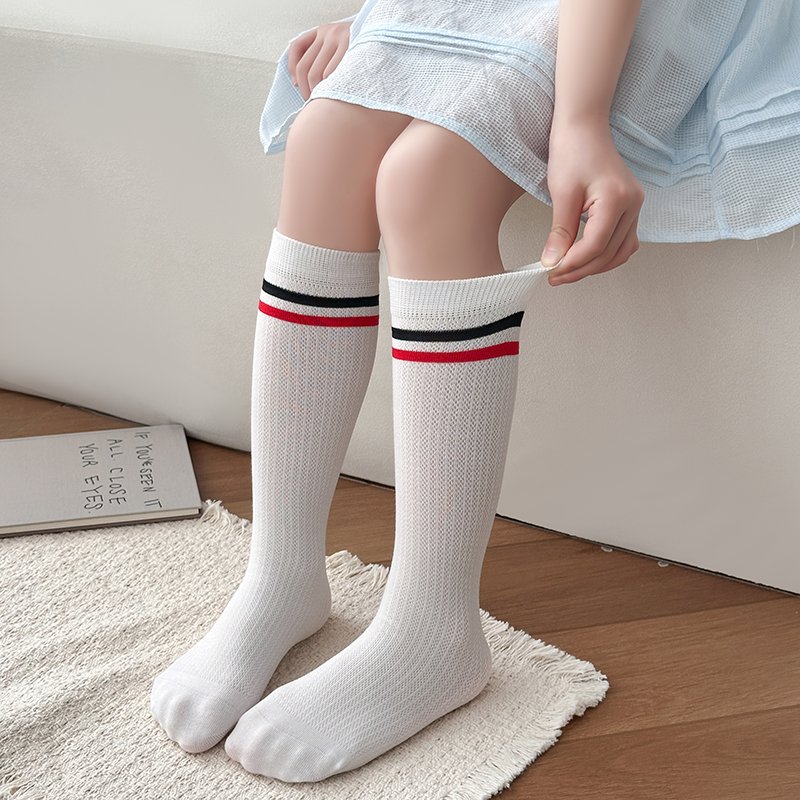
Start the enquiry with the Girls’ Mid-Calf Socks product page, the selected gallery image and the date of the saved reference. Transcribe the stated length as 40 cm without changing its meaning. A centimetre unit is supplied here, but the page name and styled image do not explain the measuring path. In particular, a catalogue category cannot establish how high a particular garment will sit on a wearer.
Give the measurement request its own revision label. Keep the original page wording in one field and the supplier’s clarification in another. If the supplier later explains that a different value or method applies to the selected reference, retain that response as a documented correction. Do not silently replace the original reference and lose the reason why clarification was needed.
• Source value: the catalogue’s stated 40 cm length.
• Method request: explicit start point, end point and measuring path.
• Sample record: actual identified garment and observations made using the agreed method.
Ask for named endpoints and a simple annotated view
Request a drawing or photograph with the two endpoints marked on the relevant garment. The supplier should state whether the definition includes a foot section, how a heel or turn is handled, and whether a cuff edge is part of the path. These are questions to resolve, not proposed descriptions of what the published 40 cm already means. An unmarked photograph is not a substitute for the answer.
Use clear component names in the working sheet and retain the supplier’s wording alongside any internal shorthand. If the reply describes an overall path while a buyer needs a leg-section value for another document, request the second definition separately. Do not subtract an assumed foot length or create a conversion formula from the styling image. Different dimensions should remain separately named until their relationship is explicitly established.
Definition field
Required clarification
Record to retain
Start and finish
Exact physical endpoints on the offered item
Annotated supplier view or drawing
Path
Straight distance, shaped path or another named method
Supplier’s actual method wording
Garment state
Condition and arrangement used for the value
Agreed definition without an invented stretch procedure
Applicable reference
Offered style and any relevant size label
Product and sample identifiers
Published value
How the stated 40 cm relates to that definition
Matched response or a documented correction
Define the garment state before making comparisons
A measurement record should describe the condition in which the item is presented. Ask the supplier which arrangement is intended for its value and use the agreed description consistently. Do not infer an extension condition from a photograph showing a hand near a cuff. The image identifies a catalogue presentation, not an instrumented measuring procedure or evidence of elastic recovery.
If a buyer requires a particular inspection method, identify that requirement for supplier discussion before recording acceptance. Keep any preparation, placement or measuring instructions explicit. Missing instructions remain an open method question. A result collected under an undefined condition should not be labelled equivalent to the supplier’s nominal value merely because the numbers happen to match.
Treat a custom length as a separate confirmed proposal
The product page mentions custom lengths, which gives the buyer a reason to ask about a particular requirement. It does not confirm every requested dimension, its availability or its effect on a quotation. Send the proposed value with the same endpoint and method definition, then ask the supplier to identify the offered version. Keep a change request separate from the original catalogue reference.
Record whether the supplier has answered the method, the proposed value and the applicable product identifier. If the answer covers only a reference sample, retain that limitation. Other commercial fields such as quantities, pricing and delivery need their own actual offer. A dimensional enquiry should not be used to invent an order quantity, lead time or stock claim that the buyer has not received.
Use the agreed definition in the sample and quote records
When an actual sample is available, record its identifier, any attached size label, the measurement-definition revision and the observed result. Record unmeasured fields as not measured. Obtain any required nominal values and tolerances separately; the single page value does not supply a production tolerance. Keep a result awaiting clarification open rather than describing it as a failed or passed specification without an agreed basis.
Send the completed question sheet through Jinyan’s contact page and retain the supplier’s answer with the reference. Related purchasing notes can point back through the Jinyan blog. The useful output is a reproducible definition connected to an actual offered item. It is not a foot-size conversion, a wearer-age recommendation or a prediction of comfort from the words mid-calf or the position shown in a photograph.
Frequently asked questions
Does 40 cm mean the sock’s leg section?
The visible page text does not define the endpoints. Ask the supplier whether that is the intended meaning and retain the actual annotated method before treating it as a leg-section dimension.
Can a photograph establish the measurement condition?
No. Catalogue poses do not define a measuring procedure. Obtain the intended garment state and path in writing or in an identified supplier drawing.
Does the custom-length wording confirm a requested version is available?
No. It supports an enquiry. The supplier still needs to confirm the particular offered version and its applicable commercial terms.
Can the stated sock length be used to recommend a shoe size or age?
Not from this evidence. Sock measurement, footwear sizing and wearer suitability are different questions; the catalogue length alone does not establish a conversion.
Product and contact references
https://jinyansocks.com/product/girls-mid-calf-socks/
https://jinyansocks.com/contact/
https://jinyansocks.com/blog/